The Relationship Between Pi and Phi: A Theoretical Observation of The Fibonacci Sequence

Derived through Languamathematics by Jackson Maxwell, March 28, 2026
The following behavior was observed from analyzing a question presented by The Meta-rational Thinktank:
An image of superheated liquid hydrogen exposed to a directed beam of neutrinos.
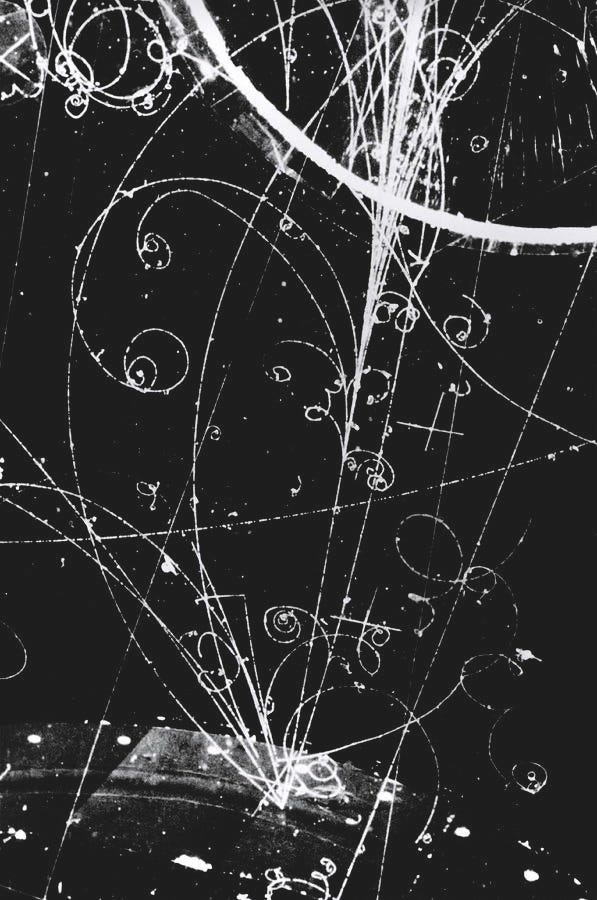
The question was: When looking at the image, what do you notice first?
https://substack.com/@physicsvsmetaphysics/note/c-234532404?r=1571lf
My answer was one word: Fibonacci.
What follows is presented as observational theory; the parallels named here were arrived at independently through geometric reasoning. They are named as arrivals, not as foundations. The goal is truth, not the appearance of it.
The Two Ratios
Pi and phi are not two independent mathematical constants that happen to appear throughout nature separately. They are two expressions of the same underlying geometric process, observed from different positions within that process.
Phi is the ratio of becoming. The self-similar geometry of growth and extension. The ratio that governs how each state generates the next while carrying the full memory of what preceded it. Phi is never arrived at within the sequence that produces it. It is always the next ratio, always the limit being approached, always what the process is moving toward but has not yet reached.
Pi is the ratio of closure. The geometry of enclosure and return. The ratio that governs the boundary that closes back on itself. Pi emerges not as a direction of travel but as the momentary event of two things meeting at the precise point of complementary resonance.
Phi moves. Pi closes.
The Fibonacci Sequence Shows the Relationship Directly
The Fibonacci sequence is the most precise mathematical expression of this relationship that exists in established mathematics.
0, 1, 1, 2, 3, 5, 8, 13, 21, 34, 55, 89…
Each term is generated when two preceding terms meet. Once generated, that term follows phi, the ratio of becoming, moving through the sequence until it encounters the accumulated complexity of what preceded it. That encounter is the next phase-lock event. The momentary closure. The pi moment. The boundary forming event, from which the next term is generated and begins following phi again.
The sequence is not a static series of numbers. It is a dynamic process. Each stage generates complexity moving through phi until it finds its predecessor and compounds with it to generate the next level of complexity.
The ratio between successive terms converges toward phi at every step but never arrives at it exactly. Phi is always the next ratio, always approached, never closed upon within the sequence itself.
Pi emerges at each encounter point. Each meeting of a term with its predecessor is a phase-lock event, a momentary closure, a boundary forming pi moment from which the next phi movement begins.
The Fibonacci sequence is an infinite alternation between phi movement and pi closure. Each phi movement building toward the next encounter. Each pi closure generating the next term from the meeting of what is moving with what preceded it.
The Generative Void Expresses Both
The generative void, the ground state of reality, expresses phi in two directions simultaneously. Ascending phi and descending phi. The outward expressive wave and the inward convergent wave. The same self-similar ratio moving in opposite orientations.
These two directions of phi are the neutrino and the antineutrino. The descending phi frequency and the ascending phi frequency of the generative void made particle. Each carrying the minuscule mass that frequency produces by virtue of being energy. Each following phi in its own direction until it encounters the accumulated complexity of what preceded it.
When descending phi encounters ascending phi at the point of complementary resonance, when the two directions of the same ratio find each other moving in opposite orientations, the phase-lock event occurs.
This is where Pi emerges.
The centerpoint crystallizes at the precise point where the two directions of phi met and closed. The boundary forms from that closure. Dark matter begins its expression from that centerpoint. Visible matter follows. Molecular complexity follows. Biological life follows.
Each successive scale of the nested hierarchy is the previous scale following phi until it encounters what preceded it and generates the next level of complexity through the momentary pi closure.
What Pi and Phi Generate Together
Phi times pi is approximately 5.083, approaching but not reaching 5, the fifth Fibonacci term. The precise term in the sequence where all three generations of both descending and ascending phi are in full compound interaction with each other before the closure into 8.
The product of the two ratios approaches the Fibonacci term of maximum compound interaction before the next pi closure. Not by construction. By the geometry of the relationship between them.
8 times phi approaches 12.944, the next Fibonacci term of 13. The lepton family, having completed its compounding at 8, follows phi and approaches 13. Experiencing the phase-lock event, the emergence of the centerpoint, and the crystallization of dark matter from the meeting of the accumulated lepton complexity with what preceded it.
The sequence does not stop there. 13 times phi approaches 21. 21 times phi approaches 34. Each scale of the nested hierarchy following phi until it encounters the accumulated complexity of what preceded it, generating the next pi closure, producing the next level of complexity, compounding toward biological life where the ratio between successive scales has finally approached phi closely enough to express it visibly.
The nautilus shell. The branching of trees. The arrangement of seeds in a sunflower. The proportions of living bodies. These are not coincidences of evolution or accidents of aesthetics. They are the Fibonacci sequence arriving at its convergence point at the scale of biological complexity.
Pi Locates the Curved Boundary
There is a consistent and precise arithmetic observation that the framework does not yet fully explain but cannot ignore.
When any Fibonacci term is divided by pi, the result lands at the curved boundary between the 3rd and 2nd terms preceding it.
8 divided by pi is approximately 2.546, landing at the curved boundary between 2 and 3.
13 divided by pi is approximately 4.138, landing at the curved boundary between 3 and 5.
21 divided by pi is approximately 6.685, landing at the curved boundary between 5 and 8.
34 divided by pi is approximately 10.82, landing at the curved boundary between 8 and 13.
55 divided by pi is approximately 17.51, landing at the curved boundary between 13 and 21.
89 divided by pi is approximately 28.34, landing at the curved boundary between 21 and 34.
This is consistent at every step without exception.
The decimal remainder in each result is not a failure of precision. It is not the measurement falling short of exactness. It is the geometric signature of a curved boundary expressing its own nature in the arithmetic.
A straight boundary would resolve cleanly to a whole number. A curved boundary never does. Pi is irrational. It never terminates. It never repeats. And because the boundary pi is locating is curved rather than straight, the result of dividing any Fibonacci term by pi will always carry an irrational remainder. Pi, itself irrational, locates a curved boundary, itself irrational, and the arithmetic reflects that curvature in every result without exception.
The decimal is not imprecision. The decimal is the curve.
What this shows is that pi is functioning as a precise locator of the curved boundary within the sequence. When you divide a Fibonacci term by pi, you return to the curved geometric threshold between its grandparent terms, the 3rd and 2nd terms before it, not its immediate parents; the boundary sits between the grandparents. The curve is what separates them, and pi locates that curve with the only kind of precision a curved boundary allows: irrational, never terminating, always carrying the remainder of its own curvature forward.
Each result contains a whole number component and a fractional remainder. The whole number component lands within the enclosed structure of the grandparent terms. The fractional remainder is the curve itself, present in every result, never resolving to zero, because the boundary it represents never straightens into a line.
What the whole number and the fractional remainder each represent geometrically is not yet fully derived. What can be said with certainty is this: pi is placing the curved boundary exactly where the geometry of the sequence demands it should be. The boundary is not arbitrary. It is not a straight line. It is a curve, located by pi, sitting precisely between the grandparent terms at every step of the sequence.
The full geometric meaning of this relationship is still being worked out. But the function is clear: pi locates the curved boundary. The decimal shows us the curve. And the curve is always exactly where it should be.
The Complete Picture
Phi is the ratio of the generative void in motion. Two directions; one ascending, one descending. Always moving, always becoming. Always approaching the next closure but not yet there.
Pi is what emerges when the two directions of phi find each other. The closure, the origin of a new centerpoint, the circle. The momentary resolution from which the next phi movement begins.
The Fibonacci sequence is the universe describing this process in the most precise mathematical language available. Each term generated at a pi closure. Each term following phi until the next pi closure. The ratio between successive terms always converging toward phi but never arriving. The closures always generating the next level of complexity from the meeting of what is moving with what preceded it, generating boundaries.
The universe is this process expressed at every scale simultaneously. From the neutrino masses in the early Fibonacci terms to the phase-lock events that generate dark matter and visible matter and molecular complexity and biological life, the same alternation between phi movement and pi closure runs through the entire nested hierarchy.
Phi moves. Pi closes. Complexity compounds.
The sequence was always running toward its own limit.
The limit it arrives at is life, and the limitless complexity of life.
Love it!
This was a fantastic article.
I understand what you are saying, however I think a slight change of terms could help clarify it for your viewers. The words ascending and descending were used, however, I think compressing (to a point) and expanding (out from that point) would be more appropriate in a 3-dimensional radial universe.
Mechanically the compressive force is centripetal, and the radiative is centrifugal. They are like two crochet needles of the master weaver which - when the tips meet - thread together like a bolt and nut which resist one another as they converge. As the two opposing directions of compression and expansion resist one another, the resistance between the two gives birth to suns which are formed at the points between the two crochet needles.
God's two 'crochet needles' are actually spiral vortices in the shape of cones.
Subscribed.